Before Beli, there was Listt

It always started the same way. Someone in the group chat asks "where should we eat Saturday?" and suddenly I'm an archaeologist, digging through my Google Maps saves, saved Instagram posts I'll never find again, and a vague memory of a friend raving about a fried chicken place whose name I never wrote down. 45 minutes later we end up at the same place we always go.
This was around 2022, and my friend Amna and I decided this was a problem worth solving. Here's how we saw it: when you're deciding where to eat, the information landscape is complete chaos. Google Maps and TripAdvisor are a bunch of strangers leaving reviews you don't care about. I don't know you, Gary from Basingstoke, and your two-star rant about the parking situation means nothing to me. The people whose opinions you do care about: your foodie friend, that one blog, the influencer whose taste you actually trust - are scattered across a dozen platforms. And your own lists aren't in better shape: Amna and I both kept ours in Google Maps, which gives you hardly any way to organize, sort, or share them properly, while everyone else we knew was juggling spreadsheets, notes files, and camera rolls. Because pulling all of that together takes effort, you default to what you know and miss out on the best your city has to offer.
So that was the bet: people want one place where the ratings around them come from people they actually trust. Friends, blogs, critics, your own curated circle instead of the entire internet. Open the app, see what's popular with your people near you, done. But honestly, the bet came second. The real reason we built it was that we needed this thing in our life. I didn't care what anyone else thought, this had to exist, and nobody else was making it.
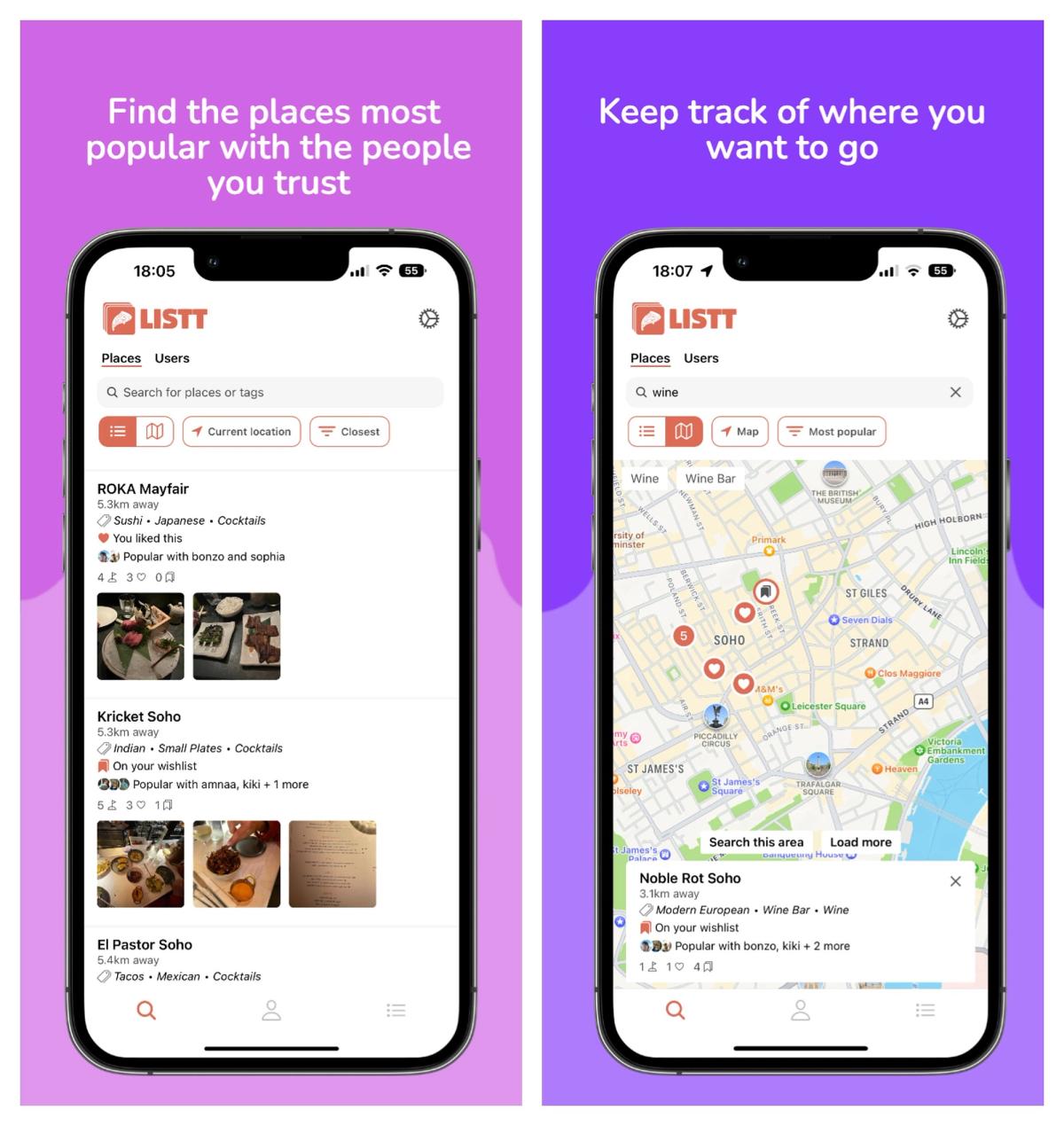
What made it feel like a product and not just a personal itch was the incentive loop. Because here's the thing: people love making lists. People love ranking stuff. Especially when their friends are watching. There's a very human urge to show off where you've been, and if you build a place where posting your list gives you clout, that same clout chasing makes the app more valuable for everyone who follows you, which makes them want to build their own lists, which makes it more valuable for their friends, etcetera etcetera. A flywheel powered entirely by people wanting to look like they know the good spots. Beautiful.
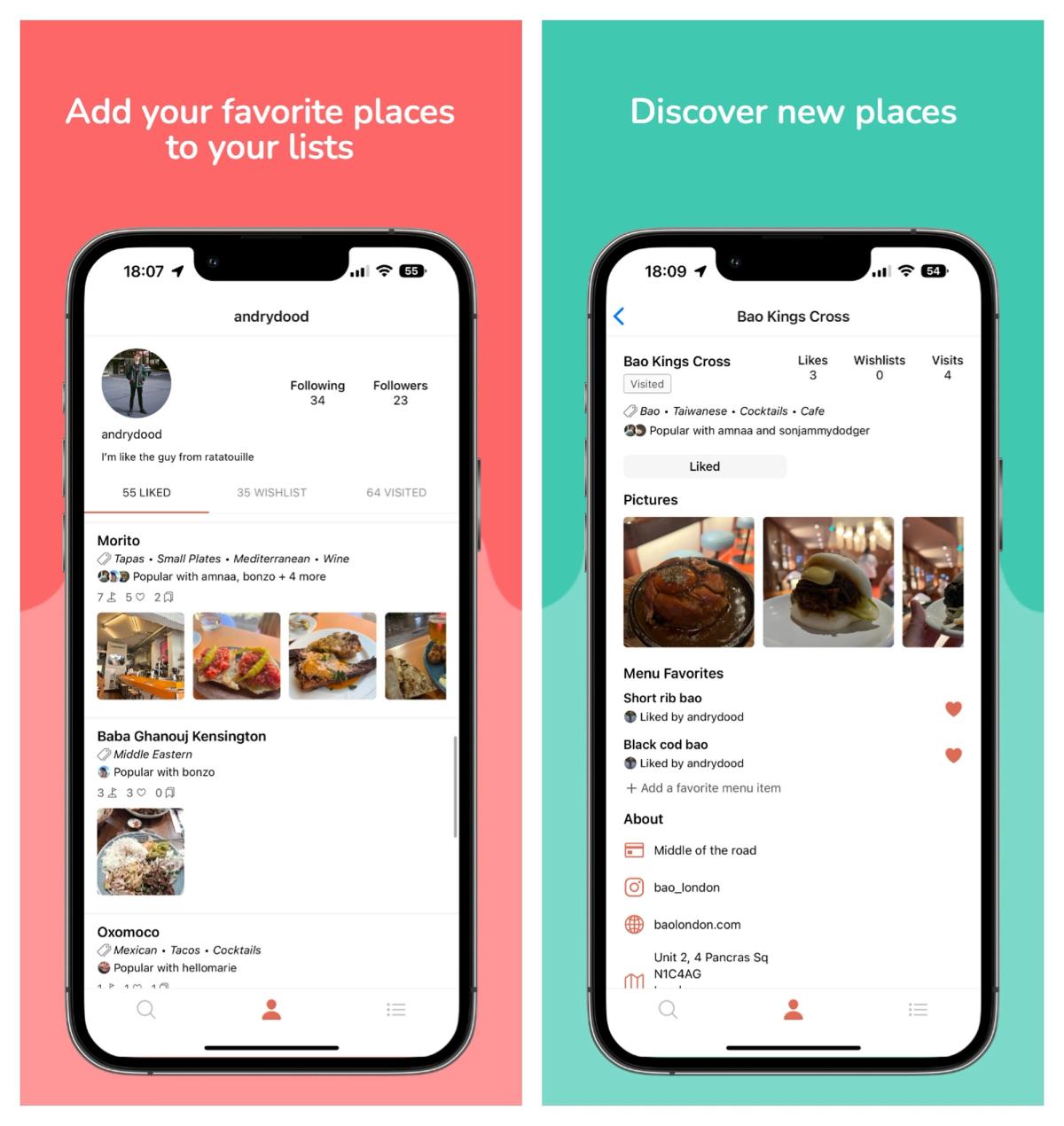
And so we built Listt. You could mark places as wishlisted, liked, or visited, tag them by cuisine and vibe, follow your friends, and search for places near you sorted by what's popular with the people you follow. We split it along our strengths: I designed the entire UI/UX and wrote all the code: a React Native app talking to a Node and MongoDB backend on AWS, while Amna ran everything else: strategy, metrics, user research, growth. Two massive foodies with strong technical backgrounds who genuinely needed this thing to exist. Founder-market fit doesn't get much better than that.
The biggest problem we faced was data. A places app with no places in it is just a very sad empty feed, and we couldn't exactly scrape Google Maps (wouldn’t want to go against their terms of service), and this was before the mass use of AI, so there was no magic wand to conjure a structured database of every restaurant in London. Our solution was scrappy but worked: we took our own lists of favorite restaurants, around 500 places, and loaded them onto the platform with a script. If users wanted to add a place that wasn't there, they could request on the app it and one of us would add it on the backend using that same script. This was unlikely to scale, but all we wanted to do was to prove the idea worked.
We released it on TestFlight first, then the App Store. Friends and family came first, then friends of friends, and eventually we amassed hundreds of users, some of whom became weekly actives, which for a two-person operation felt amazing. People were telling us they'd been to places they would never have found otherwise, that they could get from "where should we go" to a shortlist in seconds. The thing we needed in our lives turned out to be a thing other people needed too.
And for a while we were riding high. We kept shipping: a map view so you could see what was popular in a neighborhood at a glance, highlighting what people were loving on the menu at each place, surfacing spots that were sitting on multiple friends' wishlists. We had weekly metric check-ins, a proper strategy doc, engagement north stars, the works. I was learning about product strategy, mobile app development, and AWS at a pace no job had ever taught me, and having fun doing it. There's something about building a thing with your friend that people actually use that not much can replicate.
Then life started catching up with us. Growth takes relentless energy, and ours began to dip: Amna had to step away for personal reasons right around the time I was ramping up on a new team at work. I thought hard about carrying it forward alone, but I know how I work best: in a team, pushing with someone who's as invested as I am. The relationship Amna was half the engine of Listt, and this type of work is only worth doing if you’re willing to give it 100%, so we made the hard call and wound it down.
Shutting it down was the right move given our circumstances, but it wasn’t easy giving up on this passion project. Then a couple of years later, Beli showed up: rank the restaurants you've been to, follow your friends, see what's popular with people you trust. The exact same thing. And it blew up. Every time someone shows me their Beli profile I experience a very specific emotion that's about 70% validation and 30% something I'd rather not name. We were right about the problem, right about the bet, right about the clout loop. We just weren't there when the market caught up.
But what's left is more than a good story. Listt is where I proved I could go from ideation to validation and take a product all the way: design a UI/UX people loved, ship the full stack, and wrap it in strategy. The idea had worked, the timing just wasn’t right, but next time I find something I need to exist that badly, I know exactly how to build it. And I've still got a genuinely great list of 500 restaurants.